

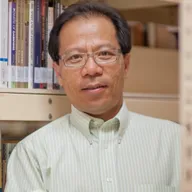
K. K. Yeo
Garrett-Evangelical Seminary
Collaborating Network
Affiliations
Harry R. Kendall Professor Emeritus of New Testament at Garrett-Evangelical Seminary, Evanston
Affiliate Faculty, Department of Asian Languages and Cultures, Northwestern University, Evanston, USA
Biography
K. K. Yeo (楊克勤) is Harry R. Kendall Professor Emeritus of New Testament at Garrett-Evangelical Theological Seminary and Affiliate Faculty in the Department of Asian Languages and Cultures at Northwestern University. He has collaborated with the Global Faculty Initiative since 2020 and has served as Vice President of its Board since January 2023.
Born in Malaysia and trained at Northwestern University in New Testament, classics and rhetoric, he brings Pauline studies into conversation with the classical traditions of China, reading Paul alongside Confucius and the Zhuangzi. He also writes on the beauty of Scripture as expressed in music, rhetoric, painting and prayer. He was a Lilly Faculty Fellow (1999–2000) and a Henry Luce III Fellow in Theology (2003–2004), and is an elected member of Studiorum Novi Testamenti Societas.
For more than three decades he has taught and lectured across China, Asia, Australia, Europe and the Middle East. He has held visiting professorships at Peking, Fudan and Zhejiang Universities and at Minzu University of China, and co-directed a research center at Tsinghua University (2015–2021).
He has authored or edited more than forty books in Chinese and English. These include What Has Jerusalem to Do with Beijing? (2018) and The Oxford Handbook of the Bible in China (Oxford University Press, 2021), which he edited. He also co-edited the six-volume Majority World Theology series. With colleagues, he helped establish graduate programs in Christian and biblical studies at Peking University and has edited eight book series comprising more than 70 volumes.
Research Focus
- How is one’s own “culture” understood differently by ethnic, national, social and religious groups in our world today especially in light of the way we understand identity, ourselves and our world [hermeneutics]? This is particularly acute for those of us who have been and continue to be exposed to multiple cultural identities and meanings as we have moved through our lives.
- What is the role of cultures in the Bible and in biblical interpretation?
- Is the salience of cultural context limited only to ways we approach the contexts of the Bible and its authors?
- And/or is culture itself also the lens through which the biblical authors or readers down through the centuries of the Christian tradition express and understand the biblical message?
- Are the cultures of the Bible also to be seen as part of the content in the Bible as well as in our biblical interpretation?
- Is “cross-cultural” biblical interpretation necessary? What is it? And why or why not should we engage in cross-cultural interpretation and theology?
GFI Writings

K. K. Yeo
Garrett-Evangelical Seminary
Genuine Love: Confucian Ren Meets Pauline Agapē
The Fall of Love: Fragmented Thinking and Polarizing Violence # Love is beleaguered in a world filled with polarization and violence. Jealousy, bigotry, hubris, and resentful revenge are traits Paul described in 1 Corinthians 13:4–5 as signs of a troubled Roman society, and they are appearing…
K. K. Yeo
Garrett-Evangelical Seminary
Can We Talk About Love Responsibly Without Cross-Cultural Hermeneutics?
Love is beleaguered in a world that is increasingly polarizing and violent. Can we even begin to talk about “love” that can mend the rifts caused by “irreconcilable” opinions about “love”? In times like these, I appreciate the refreshing and succinct insights of Prof. O’Donovan’s Preview on Love (he…
K. K. Yeo
Garrett-Evangelical Seminary
Virtues Across Cultures and Disciplines: From Proverbs and Paul to Confucius
Introduction # Given the increasingly diverse and globalized world we live in, Herdt’s inspiring work on the pagan and Christian sources of classical traditions in virtue ethics has encouraged me to explore and uncover ethical and religious virtue traditions in the worlds of the ancient Near E…
K. K. Yeo
Garrett-Evangelical Seminary
The Created Universe and Naturalistic Cosmos: A Cross-Cultural Conversation with a Chinese Theologian
I find Prof. Biggar’s “Order” essay enlightening and evocative as it relates to my cross-cultural field of Pauline and Confucian studies. [ 1 ] Biggar’s thesis that, “Modern Western culture warms to freedom and shies away from order... Different histories, however, produce different…
K. K. Yeo
Garrett-Evangelical Seminary
Confucian Ethics and Pauline Theology Can Speak to Each Other
I appreciate Prof. Herdt’s theoretical and practical considerations on the life of virtues. Her inspiring work regarding the pagan-Christian sources in western classical traditions on virtue ethics encourages me to explore the interplay of philosophical and religious virtue traditions in other parts…
K. K. Yeo
Garrett-Evangelical Seminary
Can Chaos Work for Good?
I find Prof. Biggar’s “Created Order” enlightening and evocative in relation to my field of New Testament study in the following three areas. 1) Monotheism and Trinitarian theology on the created order of God: Does the difference between Old Testament monotheism and New Testament trinitarianism affe…
K. K. Yeo
Garrett-Evangelical Seminary
Can Confucius and Paul Arrive at the Same Vision of Flourishing?
My first impression of the Flourishing preview is one of awe as to its density and clarity. It provokes me to raise two cross-cultural hermeneutical questions about framing its thesis by using the specific language/text in the brief (theological, philosophical, and that of Marcus, Marx, Mond). First…
K. K. Yeo
Garrett-Evangelical Seminary
Can Confucian 'Uprightness' and Biblical Justice Speak to Each Other?
The Preview evokes for me the significance that language (Hebrew, Greek, Latin, English) plays in communication of shared, core ideas, such as the nuances of meaning in that English word and concept called “justice” or “righteousness”. I am intrigued by the OT meanings that associate justice with Go…
K. K. Yeo
Garrett-Evangelical Seminary
A Contextual Interpretation of Justice and Righteousness by a Biblical Theologian
Introduction # Prof. Nicholas Wolfterstorff has written an insightful and thoughtful theological brief (hereafter NWTB) on justice and rights . Any response to such rich, dense and evocative piece is mainly an expression of my gratitude for the gift of friendship afforded by the Global Facult…